The Presence of Water
Opening 5th December at 19:00
05.12.2025 to 28.02.2026
Two books are available here
List of artwork available here
Last years exhibition with Michael Kenna was very successful and many of the visitors came a long distance to see his prints. It was a joy to see people coming because they are followers of his work and other who newly discover him as a new favourite for them.
So I sat down and thought about what can I show next time to my visitors and collectors. Since there are every year many exhibitions around the world showing Michael’s work it feels as if all has been shown already. There have been recent exhibitions on Japan, Venice, trees, bridges, concentration camps, and so on.
Reading in his Venice book I came across the following in the essay of Matteo Colla on page 151: “In the project on the Venetian territory, and in particular on the islands we explored, such as …..Michael was mainly interested in walking to their outermost edge or on the farthest points of dry land. With his gaze always turned to the water, the sky and the surrounding islands…” (he goes on with the opposite - but this is for another exhibition).
So there it was. There are not too many pictures in Michael’s work where water is the main subject, one of the few examples in the exhibition is Fierce Wind (2002), but why not look at the Presence of Water without being the main subject of a photograph. Water plays so many roles in so many of his photographs and this goes on throughout his career. Look at his homepage and you will see that water plays an important role. The exhibition will cover prints from as early as 1980 until 2024.
Now let us delve deeper into the subject:
Michael Kenna (b. 1953) has established himself as one of the most distinctive voices in late twentieth- and early twenty-first-century landscape photography. His black-and-white prints, characterised by long exposures and minimalist compositions, have been widely celebrated for their quiet, meditative quality. Among the recurring motifs in Kenna’s work—trees, piers, industrial ruins, and nocturnal landscapes—water occupies a particularly significant position. Far from being a passive backdrop, water becomes an active participant in his visual and conceptual language, shaping the mood, form, and philosophical underpinnings of his images. This essay explores how Kenna employs water as a medium of minimalism, a register of time, and a site of spiritual reflection, positioning his work within both Western and Eastern photographic traditions.
Water and Minimalism
Kenna’s aesthetic sensibility is often aligned with minimalism due to his preference for simplicity, restraint, and compositional clarity (Bright, 2011). Water, in his photographs, serves as an ideal agent for such reduction. By employing long exposure techniques—sometimes lasting several hours—Kenna transforms dynamic bodies of water into smooth, mist-like expanses. The motion of waves and currents is dissolved into pure tone and texture, creating what Barthes (1981) might describe as a “punctum of stillness” that arrests time.
In works such as Two Harbor Piers, Kyushu, Japan 2024 (see right), the surface of the water becomes a luminous plane, its reflective stillness offset by the rigid geometry of man-made structures. The result is a compositional balance that emphasises harmony and silence rather than drama. The water’s surface acts as void, providing negative space through which Kenna isolates and elevates ordinary forms into symbols of serenity and contemplation.
The Temporality of Water
A defining feature of Kenna’s work is his fascination with time—its passage, its traces, and its visualisation through photographic means. Water provides a natural vehicle for this inquiry. In contrast to traditional landscape photography, which seeks to capture a decisive moment, Kenna’s long exposures condense hours of movement into a single frame. As Szarkowski (1989) notes, this approach transforms photography from a tool of documentation into one of meditation.
Through this temporal compression, Kenna transforms water into a visual metaphor for duration and change. In White Nothe, Weymouth, Dorset, England, 1990, (see to the right) for instance, the sea becomes an ethereal mist that envelops the stones, suggesting a world both permanent and fleeting. The blurring of detail does not obscure reality but rather distills it, offering what Kenna himself calls “an invitation to dream rather than a description of fact” (Kenna, 2003). Thus, water operates as a temporal agent, visualising what the human eye cannot perceive and rendering the invisible—time itself—into visible form.
Spiritual Resonance and Eastern Aesthetics
Beyond formal and temporal considerations, Kenna’s treatment of water carries profound spiritual and emotional weight. Critics have often linked his aesthetic sensibility to Zen Buddhism and Japanese visual traditions such as wabi-sabi—the appreciation of transience and imperfection (Murray, 2010). Many prints in his work exemplify this sensibility: frozen lakes, snow-covered coastlines, and solitary structures emerging from fog evoke not grandeur but humility.
In these works, water often becomes a metaphor for emptiness and reflection, a liminal space between material and immaterial worlds. The silence and restraint of these scenes encourage a contemplative viewing experience akin to meditation. The tonal range of Kenna’s gelatin silver prints—marked by subtle gradations of grey—further enhances this spiritual atmosphere, transforming the photographic image into a visual analogue of stillness and awareness.
Human Presence and the Elemental World
While Kenna’s landscapes are all devoid of people, traces of human activity frequently appear through structures interacting with water—piers, nets, or industrial remnants. These human interventions, often stark and geometric, contrast with the organic fluidity of water, producing a tension between permanence and impermanence. Such imagery invites reflection on the fragility of human endeavour against the cyclical rhythms of nature.
Water, in this sense, mediates between human and natural realms. It erodes, reflects, and envelops, suggesting both connection and dissolution. The quiet dignity of these images resists environmental sentimentality; instead, Kenna offers a vision of coexistence grounded in respect, balance, and awareness of impermanence.

Fierce Wind, Shykushi, Honshu, Japan. 2002

Two Harbor Piers, Kyushu, Japan. 2024
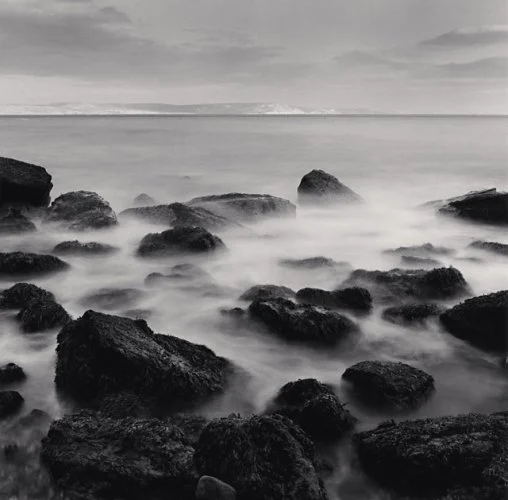
White Nothe, Weymouth, Dorset, England, 1990

Aquaculture Sticks, Noryuckdo, Jangheung, Jeollanam-do, South Korea. 2023
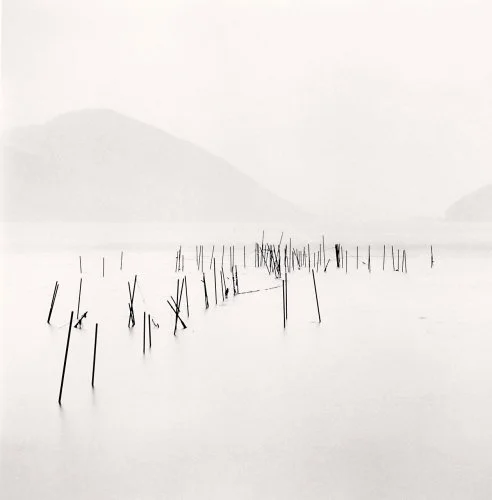
Biwa Lake Look Out, Shinga, Honshu, Japan. 2022